How to Propose: The Art of Deconstructing Her Pattern Recognition Radar
Knowing how to propose in an age of hyper-awareness is the ultimate challenge. There's a universal moment of dread every man faces before he asks the question. It’s not the fear of the “No.” It’s the subtle, almost imperceptible shift in her expression that says, "I knew it." It's the moment her eyes narrow suspiciously as you suggest a scenic walk, or when she asks, "Why are you suddenly so quiet?" In that split second, the magic of a complete surprise evaporates. In a world saturated with proposal stories, a partner's 'pattern recognition radar' has never been more acute. This isn't about grand deception; it's about subtle art. It’s about understanding that the biggest giveaway isn't a bulky ring box—it's the sudden break in your shared, daily rhythm.
The truth is, mastering the art of the surprise is a skill. The key is to make the extraordinary feel completely ordinary, right up until the second you drop to one knee. This guide will deconstruct her radar and give you the tools to create a moment of pure, unadulterated shock and joy. It's time to learn how to propose by becoming a master of emotional choreography.
| Element of Surprise | The Common Mistake (DIY Surprise) | The Expert Method (Managed Misdirection) |
|---|---|---|
| The Alibi | A vague "fancy dinner" excuse that immediately raises suspicion. | A layered alibi (like a fake escape game) that provides a logical reason for everything, from dress code to location. |
| Stress Management | Visible anxiety, constant watch-checking, and unnatural silence that screams "something is happening." | The "Aperitif Protocol": building in a relaxed, pre-proposal moment to calm nerves and normalize the atmosphere. |
| Behavioral Cues | Sudden, uncharacteristic formality or an overly planned itinerary that feels out of place. | "Micro-Habit Training": introducing new, slightly more sophisticated habits months in advance to make the proposal day feel natural. |
| Photography | Awkwardly trying to hide a photographer, which she spots a mile away. | Integrating the photographer into the alibi itself, such as posing as a street artist or a fellow tourist. |
The Psychology of the "Pattern Recognition" Radar and How to Propose
Before you can learn how to propose effectively, you must first understand the machine you're trying to outsmart: her intuition. A long-term relationship is built on a shared rhythm, a predictable dance of habits and behaviors. Her "pattern recognition" radar is finely tuned to any disruption in this dance. It’s not magic; it’s a deeply ingrained form of emotional analysis. When you, who usually lives in jeans, suddenly suggests a collared shirt for a "casual stroll," an alert is triggered. When you, who is normally relaxed on vacation, start nervously checking your phone, a silent alarm goes off in her head.
Based on orchestrating over a thousand proposals, we've identified the most common triggers that give the surprise away:
- The Time Check: This is the number one offender. A guest on holiday is supposed to lose track of time. A man about to propose is obsessed with it. Every glance at your watch is a signal that you are not in the 'vacation moment' but are instead counting down to an 'event'.
- The "Proposal Voice": Many men adopt a deeper, more formal tone in the minutes leading up to the proposal. If you're usually cracking jokes and suddenly you're speaking like a narrator in a historical documentary, she knows something is up.
- Unnatural Itinerary Control: "No, we can't go to that shop, we *have* to be at this specific spot at exactly 7:00 PM." This rigidity is a dead giveaway. Vacations are about freedom; a strict schedule is about logistics.
The biggest mistake is believing the surprise is only about the ring. It’s about protecting the emotional atmosphere. Her radar isn’t looking for a diamond; it's sensing a change in your energy. Your stress is a frequency, and she is perfectly tuned to hear it. The secret to a successful surprise is not to hide the ring better, but to hide your nerves better.
How to Propose: Normalizing the Unusual Months in Advance
The most effective strategy for bypassing her pattern-recognition radar is to retrain it. If the proposal day feels like an anomaly, it will stand out. But if it feels like the logical next step in a series of recent changes, it will blend in seamlessly. This is the "Micro-Habit Misdirection" technique, and it begins at least two months before you pack your bags. The goal is simple: make the unusual your new usual. If you're seriously considering how to propose, your planning must start now, not the week before your trip.
Here’s how to implement this strategy:
- Introduce "Dress-Up Dates": If your typical date night is casual, suddenly booking a Michelin-starred restaurant in Paris will be a blaring siren. Instead, start introducing more formal outings months earlier. Frame it as a new shared interest: "I was reading about this cool new restaurant. We should make an effort and dress up for a change." By the time you suggest a chic outfit for a night in Paris, it will feel like a continuation of a new tradition.
- Cultivate a "Plausible New Hobby": You need a reason to be interested in specific locations. Instead of mysteriously dragging her to a scenic viewpoint, cultivate an interest that justifies it.
- The Foodie: "I've been getting really into gourmet food lately. I've made a list of incredible places I want to try in Paris."
- The Culture Buff: "I just saw a documentary about Parisian architecture. There are a few historic spots I'd love for us to see."
By the time you're in Paris, the groundwork is laid. Her radar has been recalibrated. A nice shirt? "Oh, that's just his new thing." A reservation at a fancy place? "He's been so into food lately." The proposal day just becomes the most surprising of these new date nights, rather than an event that came out of nowhere.
The "Aperitif Protocol": How to Propose by Melting Pre-Proposal Stress
Even with the best-laid plans, one force can sabotage everything: your own adrenaline. This is where we implement a non-negotiable step: the "Aperitif Protocol." It is, by far, the most critical element in learning how to propose without your own body betraying you. The logic is counterintuitive but effective: to prepare for the biggest moment, you must first do absolutely nothing. We always instruct our guests to arrive in the proposal vicinity one to two hours early. Not to pace back and forth, but to sit down at a nearby café. Order a drink—a crisp glass of Chardonnay, a coffee, whatever brings you calm.
The objectives of this protocol are twofold:
- To Kill the "Countdown Clock": Arriving early eliminates the fear of being late. This removes the primary source of frantic energy and constant watch-checking. You are no longer racing against time; you are leisurely waiting for it. Your partner sees you relaxed, sipping a drink. Her brain categorizes this as "vacation mode," effectively disabling her suspicion radar.
- To Smooth Your Emotional Curve: A pre-proposal drink or even just the act of sitting still helps to smooth the jagged line of anxiety into a gentle, upward slope. You aren't getting drunk; you are performing an emotional reset. It allows you to shift from high-alert planning to present-moment enjoyment. When it's finally time to "take a walk," you are calmly suggesting a continuation of the pleasant afternoon you're already having.
This protocol turns your biggest liability—your stress—into your greatest asset. Your calmness becomes the ultimate misdirection. She has zero reason to suspect that in a few short minutes, her life is about to change forever.
Tactical Alibis: How to Propose Using an Escape Game or the "10 Euro Photographer"
A good alibi doesn't just provide a reason to be somewhere; it creates an immersive story that makes the real reason invisible. For guests who need a stronger narrative when they are learning how to propose, we design robust scenarios like the "High-Concept Event" and the "Innocent Bystander."
The High-Concept Event: This involves creating a believable activity that justifies the time, location, and dress code. Our "Gatsby Themed Escape Game" is a prime example. Her mind is occupied by the game, the puzzles, and the theme. The walk along the Seine to the "secret entrance" feels like part of the experience. Every logistical element is masked by the alibi's storyline. If she's too relaxed and doesn't want to leave the pre-game drinks, a simple, "I know, but our booking is timed, and they're really strict" creates gentle urgency without revealing the true stakes.
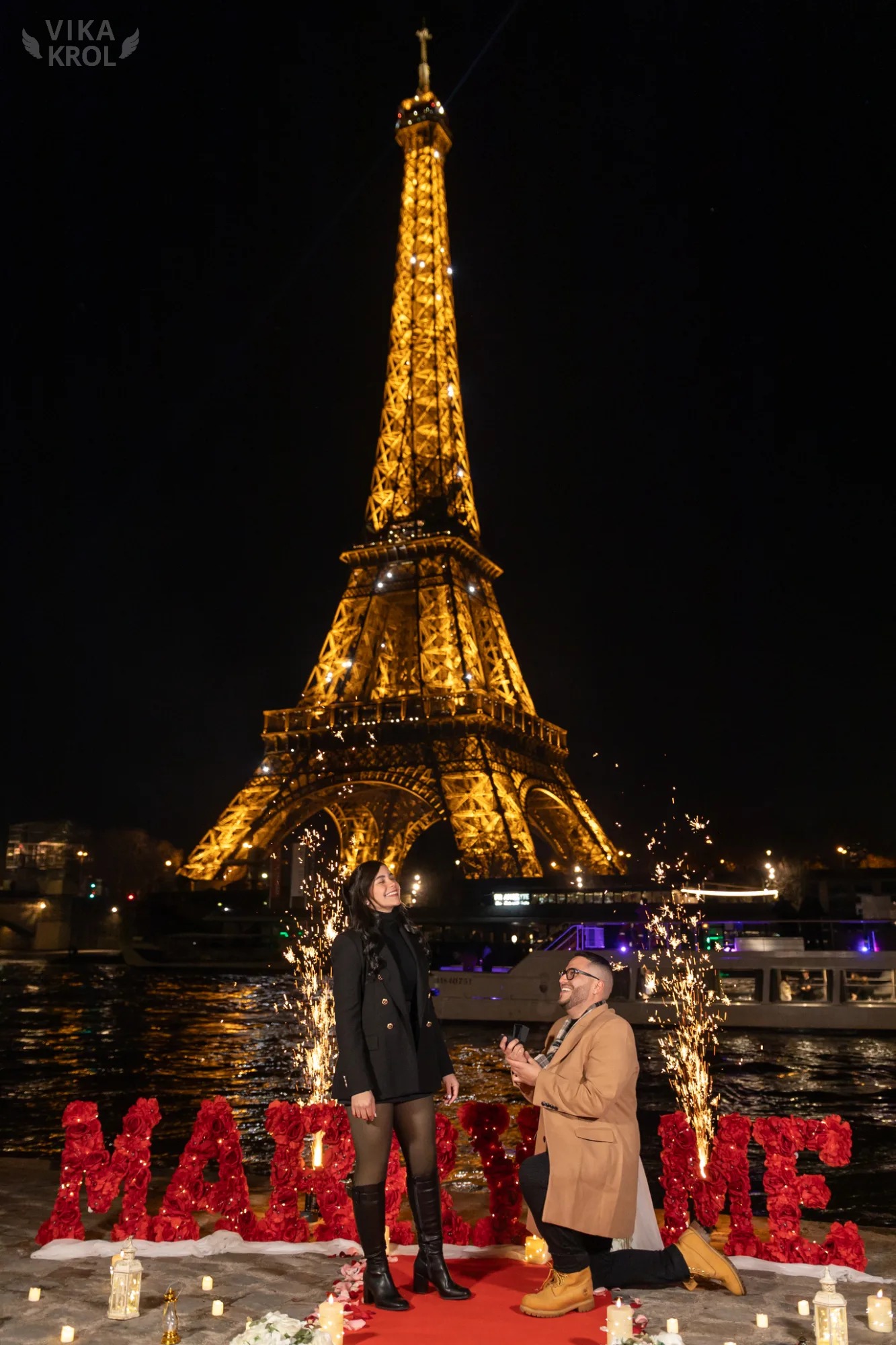
The Innocent Bystander (The "10 Euro Photographer" Ploy): For guests who fear complexity, a simpler method is better. A professional photographer from our team "randomly" approaches the couple: "Bonjour! 15 professional photos for just 10 euros?" It's a believable tourist trap. She is completely at ease, posing for what she believes are cheap souvenirs. Then, as the Eiffel Tower begins to sparkle, the photographer gives a subtle cue. The man drops to one knee. The surprise is absolute, and the entire sequence—including her raw, shocked reaction—is captured perfectly.
How to Propose: Sequencing The Letter, The Speech, and The Sparkle
The moment itself is a dizzying cocktail of emotion. For many men, the rehearsed speech evaporates the second they kneel. This is why choreography is crucial. Learning how to propose is as much about physical sequencing as it is about emotional resonance. One of the most powerful tools to solve a mental "white-out" is a physical letter. One guest, terrified of forgetting his speech, wrote a long letter. Just before the moment, he stopped and said, "There's something I want you to read."
This act accomplished several things:
- It grounded the moment: She was quietly absorbed in his written words, allowing each sentence to sink in.
- It created a visual masterpiece: Our cameras captured the range of emotions on her face as she read—a narrative within the narrative.
- It controlled her gaze: While she was reading, she faced away from the proposal setup, giving him perfect cover to get into position.
When she finished, she looked up, her heart full. He prompted her to turn around. The scene was revealed, the Eiffel Tower began to sparkle, and the impact was monumental. For those who prefer a spoken speech, the sequence is just as important. The correct order is: approach, speak, then kneel. Do not kneel and then try to deliver a long monologue. Your words need to be heard before the shock of the visual takes over.
Vika Krol Expertise: How to Propose Without a Single "Leak"
Your only job is to be present and in love. Our job is everything else. The difference between a stressful proposal and a magical one is invisible coordination. When a man plans a proposal himself, he is the timekeeper, the navigator, and the photographer's contact. This is why stress often leaks out. After personally executing over 1,000 proposals with a 5-star Google rating, the Vika Krol Club has perfected the art of the "ghost concierge." On the day, a personal coordinator manages the entire timeline, from syncing with the Eiffel Tower's sparkle to cueing the music. They are your on-the-ground anchor. A critical part of learning how to propose successfully is knowing when to delegate the pressure.
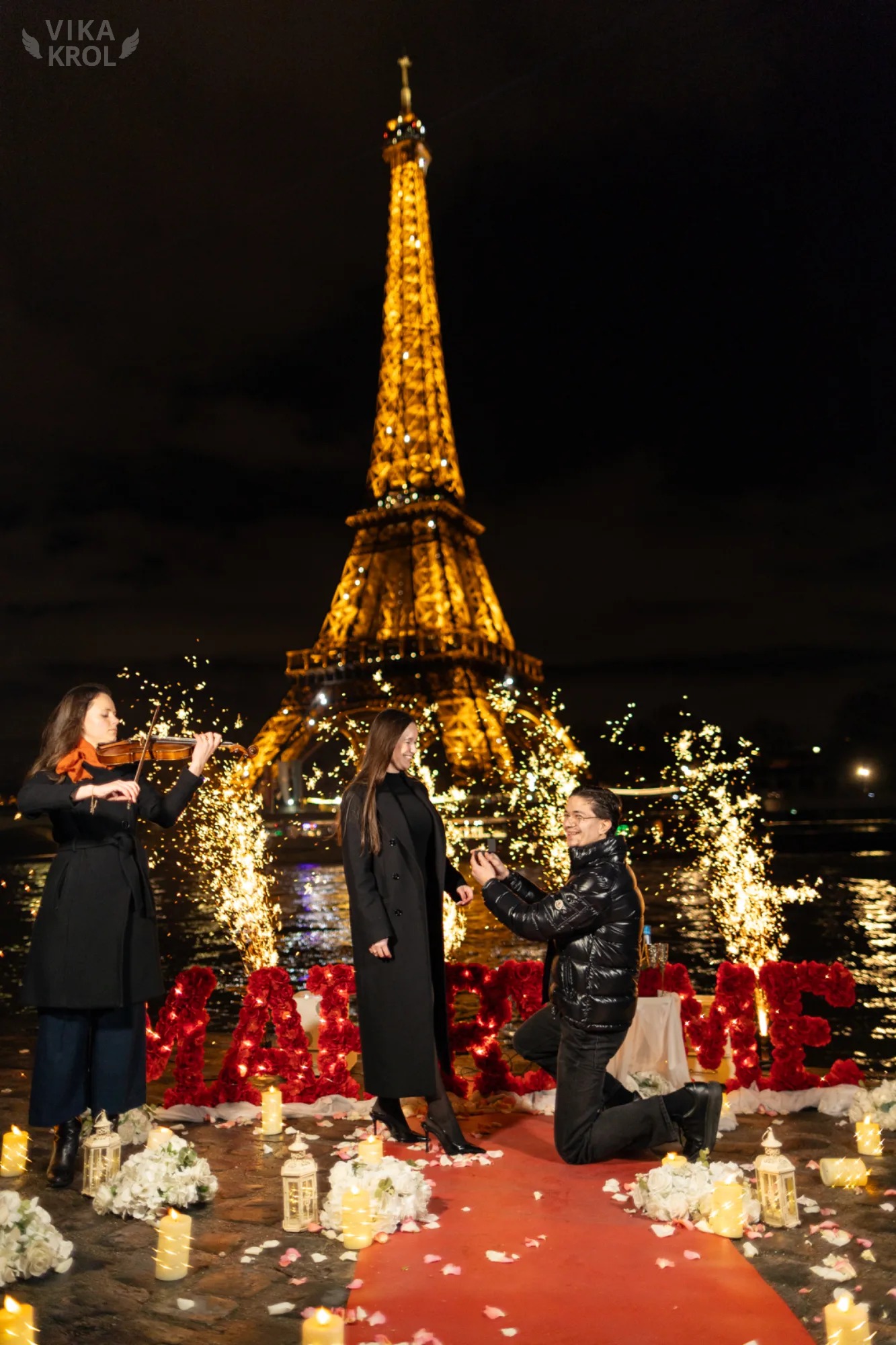
This "invisible luxury" is the secret ingredient. It allows you to genuinely relax during the "Aperitif Protocol" and be fully engaged in the moment. Your partner's radar detects no anomalies because, from your perspective, there are none. You are simply enjoying a perfect day in Paris. We handle the pressure so you can handle the emotions. This is the alchemy of transforming logistical chaos into pure, unadulterated magic.
How to Propose Like a Pro: Trusting an Expert with Your "Yes" Moment
Ultimately, planning a proposal is an act of profound love, but the process can become a source of immense stress. The desire to create a perfect moment can ironically lead to the anxiety that undermines it. While the journey of learning how to propose can be done alone, partnering with a specialist transforms the experience from a high-stakes mission into a beautiful memory. It's the difference between being the frantic stage manager and being the lead actor. An expert doesn't just provide a service; they provide peace of mind. A seasoned proposal planner has navigated every possible challenge and anticipates the pitfalls you can't see. Entrusting your proposal to an expert is an investment in the quality of your own memory of the day. You get to feel the joy and emotion without the distraction of a mental checklist. Your "Yes" moment deserves nothing less.
How to Propose: Frequently Asked Questions
Here are answers to common questions we receive from guests learning the art of the surprise—essential details for when you how to propose while keeping your partner's radar completely deactivated.
When learning how to propose, what should I do if she suspects something?
If she jokingly asks, "Are you going to propose?", the key is to react with playful dismissal, not panic. A nervous denial is a confirmation. Instead, laugh and say something like, "Yes, obviously. That's why we're at this random cafe. It's all part of my master plan." By treating her suspicion as absurd, you invalidate it. This confident misdirection will usually reset her radar and make her feel like she was just being paranoid.
For a surprise 'how to propose' moment, how do I hide the ring box?
The modern bulky ring box is a dead giveaway. To keep the surprise, invest in a slim-profile ring box, which is designed to be as thin as a wallet. Another effective method is the "sock trick": place the ring (in a small pouch) inside the cuff of your sock. It's surprisingly secure and invisible. The most foolproof solution, however, is the "hand-off." Your on-site coordinator can hold the box and discreetly hand it to you seconds before you need it, eliminating the problem of concealment entirely.
To maintain the surprise when you how to propose, should the speech come before kneeling?
Yes, absolutely. Our recommendation, based on observing over a thousand reactions, is to speak before you kneel. Hold her hands, look her in the eyes, and deliver your heartfelt message. This allows her to fully absorb your words without the overwhelming shock of seeing you on one knee. Once you have spoken, the act of kneeling becomes the powerful, non-verbal punctuation to your speech, leading directly to the question. If you kneel first, your words will likely get lost in her internal whirlwind of "Oh my God, is this really happening?"
What's the key to not revealing the surprise in the final seconds of the proposal?
Breathe, and embrace the pause. After you ask the question, there will be a moment of silence. It might feel like an eternity. Do not rush it. This is her moment to process the shock and the emotion. This "Three-Second Processing Gap" is neurologically necessary for her brain to catch up with her eyes. Your calm, patient presence while you wait for her "Yes" is the final, beautiful gift. It projects confidence and gives her the space she needs for her own unforgettable reaction, reinforcing the atmosphere of control you've built.
How does a planner ensure my 'how to propose' plan is completely undetectable?
A true proposal planner is a choreographer of emotion, whose primary job is to make your plan undetectable. While decoration sets the stage, the real value lies in managing the entire experience so you exhibit zero behavioral "tells." This includes creating the bulletproof alibi and acting as your "ghost concierge" on the day. Great paris proposal packages are designed to remove every ounce of logistical stress from your shoulders, so you can remain completely present and focused. It's the ultimate tool for deactivating her pattern-recognition radar for good.